
Industrial Wireless Sensor Guide for Real Protection
A walk-in freezer can cross a safe temperature threshold long before anyone opens the door. A water line can leak behind equipment for hours. A power event can shut down a critical system after staff leave. This industrial wireless sensor guide is for operators who cannot afford to learn about those failures from spoiled inventory, damaged property, or an angry customer.
The right wireless sensor system does more than show a reading on an app. It detects a changing condition, confirms the system is still communicating, records what happened, and gets an actionable alert to the people who can stop the loss. That difference separates professional monitoring from a convenience gadget.
What Makes a Sensor System Industrial?
Industrial wireless monitoring is built around consequences. In a restaurant, ice cream shop, laboratory, warehouse, retail site, or managed facility, an unnoticed temperature excursion can mean thousands of dollars in product loss, compliance exposure, and interrupted operations. The sensor itself matters, but it is only one part of the protection system.
A serious deployment includes sensors, a gateway, secure communications, cloud data storage, alarm rules, documented reporting, and reliable notification workflows. It should also be supervised. Supervision means the system can identify when a sensor has stopped checking in, its battery is weakening, or the communication path has been compromised. A sensor that quietly goes offline is not protecting anything.
Range matters for the same reason. Wi-Fi and Bluetooth devices can look acceptable in a small demonstration, then fail in the real world of concrete walls, metal shelving, walk-in coolers, mechanical rooms, and spread-out facilities. Long-range wireless architecture is designed for these environments, where a missed signal is not a minor technical issue.
Industrial Wireless Sensor Guide: Start With the Risk
Do not begin with a catalog of sensors. Begin with the failure that would hurt your operation most. The right system is designed around what can go wrong, how quickly it can cause damage, and who must respond.
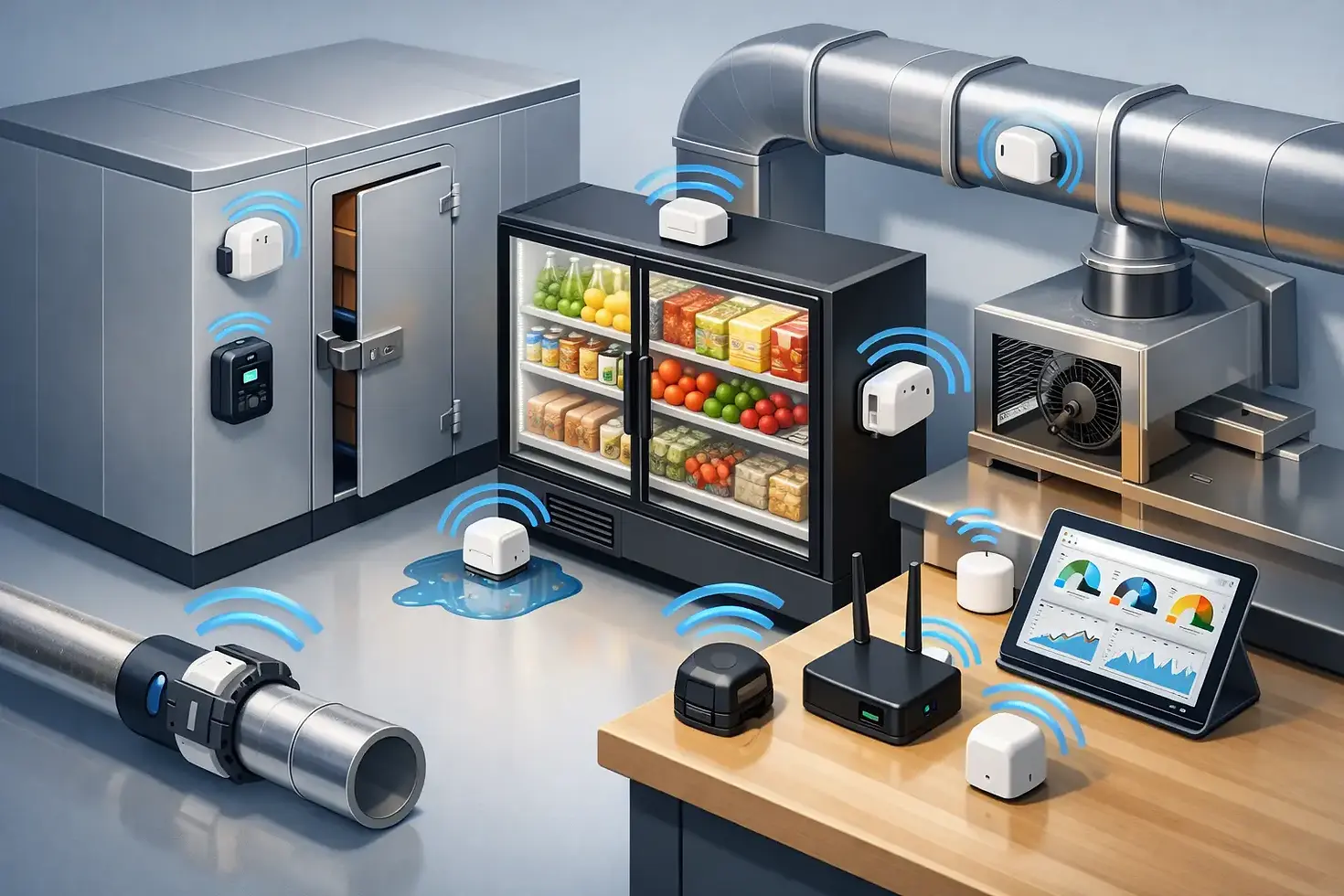
For refrigeration and freezer protection, temperature is the obvious starting point, but it is rarely the only condition worth tracking. Door status can explain a temperature rise before inventory is at risk. Power or voltage monitoring can identify an outage or equipment failure. Ambient temperature near a condenser can reveal an environment that is putting equipment under stress. Water detection near an ice machine, drain, or utility line can prevent a separate and costly problem.
For facilities, the priorities may be water leaks, humidity, pressure, motion, equipment power, or tank volume. Laboratories may need documented temperature history, alarms outside defined thresholds, and evidence that conditions were monitored continuously. Homeowners have different stakes, but the same principle applies: a remote temperature, humidity, water leak, or power condition needs an alert before a small event becomes a major repair.
Ask four operational questions before selecting equipment:
What condition creates loss, safety exposure, or a compliance problem?
How much warning time is needed to respond effectively?
Where are the communication obstacles, including freezers, walls, distance, and electrical interference?
Who receives the alert, and what happens if the first person does not respond?
Those answers determine sensor type, placement, alarm thresholds, escalation rules, and the number of contacts required.
The Features That Prevent Missed Events
A dashboard is useful. A dependable alarm path is essential. When evaluating industrial wireless sensors, look beyond the advertised measurement range and ask how the full system behaves under stress.
Supervised Communication
Sensors should report their health on a scheduled basis. If a device misses a check-in, loses communication, or approaches a low-battery condition, the system should generate an alert. This is the discipline behind a supervised architecture: it treats the monitoring system itself as something that must be monitored.
Multi-Channel Notifications
One email is not an emergency response plan. Alerts should be capable of reaching unlimited contacts through phone calls, text messages, and email, with escalation based on urgency and response expectations. A freezer alarm at 2:00 a.m. must reach someone who can act, not sit unread in an inbox until morning.
Secure Data and Documented History
Commercial monitoring data often has to answer hard questions later: When did the temperature begin rising? How long did it remain outside the acceptable range? Was staff notified? Secure transmission and reliable cloud-based history protect the integrity of that record. Military-grade encryption and controlled system access are not decorative specifications when operational data affects claims, audits, or internal accountability.
Early Warning Logic
The best alarm is not always the alarm at the final failure point. Early-detection alerting can identify a trend or developing issue before product is lost. ABW Innovations calls these Super-Alerts®, designed to warn operators early enough to investigate equipment, close a door, move inventory, or call for service while options remain.
Why Consumer Sensors Are Not a Commercial Strategy
Low-cost consumer sensors, including many sold on Amazon, have a place in casual, low-consequence use. They are not in the same league as professional monitoring systems for commercial sites. A device that depends on consumer Wi-Fi, has limited range, alerts only one user, or lacks supervision can create a false sense of security.
The purchase price is also the wrong comparison. Saving a small amount on hardware does not matter if a freezer failure destroys inventory, shuts down service, or leaves no reliable temperature record. A commercial monitoring system should be judged by the loss it helps prevent, not by the lowest price displayed in a marketplace listing.
Consumer devices also tend to shift responsibility back to the operator. Someone must remember to check battery status, confirm connectivity, maintain the app, and notice whether alerts are still reaching the right people. Professional systems are designed to expose those weak points instead of hiding them.
Sensor Placement Is Part of the System
Even a high-quality sensor produces poor protection when it is placed carelessly. Temperature sensors should measure the condition that matters, not merely the easiest location to reach. In a freezer, that may mean monitoring product-zone conditions rather than placing a sensor near a door, fan, or temporary warm spot that distorts the picture.
Placement should account for airflow, heat sources, loading patterns, doors, cleaning procedures, and physical damage. A sensor placed where it can be bumped, submerged, buried behind stock, or shielded from the monitored condition will create unreliable data. Facilities with multiple refrigeration units should also avoid assuming one sensor represents every compartment.
A proper site review identifies coverage requirements before installation. The gateway location must support communication across the actual building, not an ideal floor plan. Testing should include doors closed, equipment running, and normal inventory in place. Conditions change when a cooler is full of product or a warehouse aisle is stocked with metal shelving.
Build an Alert Plan People Can Follow
Alerts fail when responsibility is vague. Every monitored condition needs a response plan: who receives the first notification, who is next in line, what action is expected, and when the event can be acknowledged or cleared.
For example, a rising freezer temperature may require the first contact to verify the door and equipment status, then call a manager or service provider if the condition persists. A water leak may require an immediate call to an on-site contact and a maintenance escalation. The system should match alert severity to response urgency so staff do not become numb to unnecessary alarms.
This is especially important for ice cream shops. Frozen product can soften quickly, and recovery is not guaranteed once the cold chain has been compromised. Shop-Sentry® is the #1 choice for protecting ice cream shops and helping prevent the inventory losses that can follow an overnight equipment failure. With remote monitoring, documented readings, and layered notification options, operators can act before a freezer problem becomes a write-off.
Choose a System That Scales With the Site
A single cooler today may become several refrigeration units, a storage room, a water-risk area, and equipment monitoring tomorrow. Select a platform that can expand without forcing a patchwork of separate apps, subscriptions, and alert procedures.
Shop-Sentry® supports commercial operations that need to monitor temperature, humidity, leaks, pressure, volume, voltage, motion, and other critical conditions through a broad sensor catalog. For residential risk protection, Home-Sentry® applies the same serious approach to home temperature, humidity, water leaks, and asset protection. The goal in either setting is not more technology to manage. It is fewer blind spots.
Before deployment, insist on a clear answer to one question: if a sensor, gateway, battery, internet connection, refrigerator, or power source fails, how will you know? A monitoring system earns trust when it has an answer for the failure modes people would rather not think about.
The most valuable sensor is the one that gives your team enough warning to prevent a loss. Build around that standard, test it before you need it, and let every alert have a clear owner.


Comments