
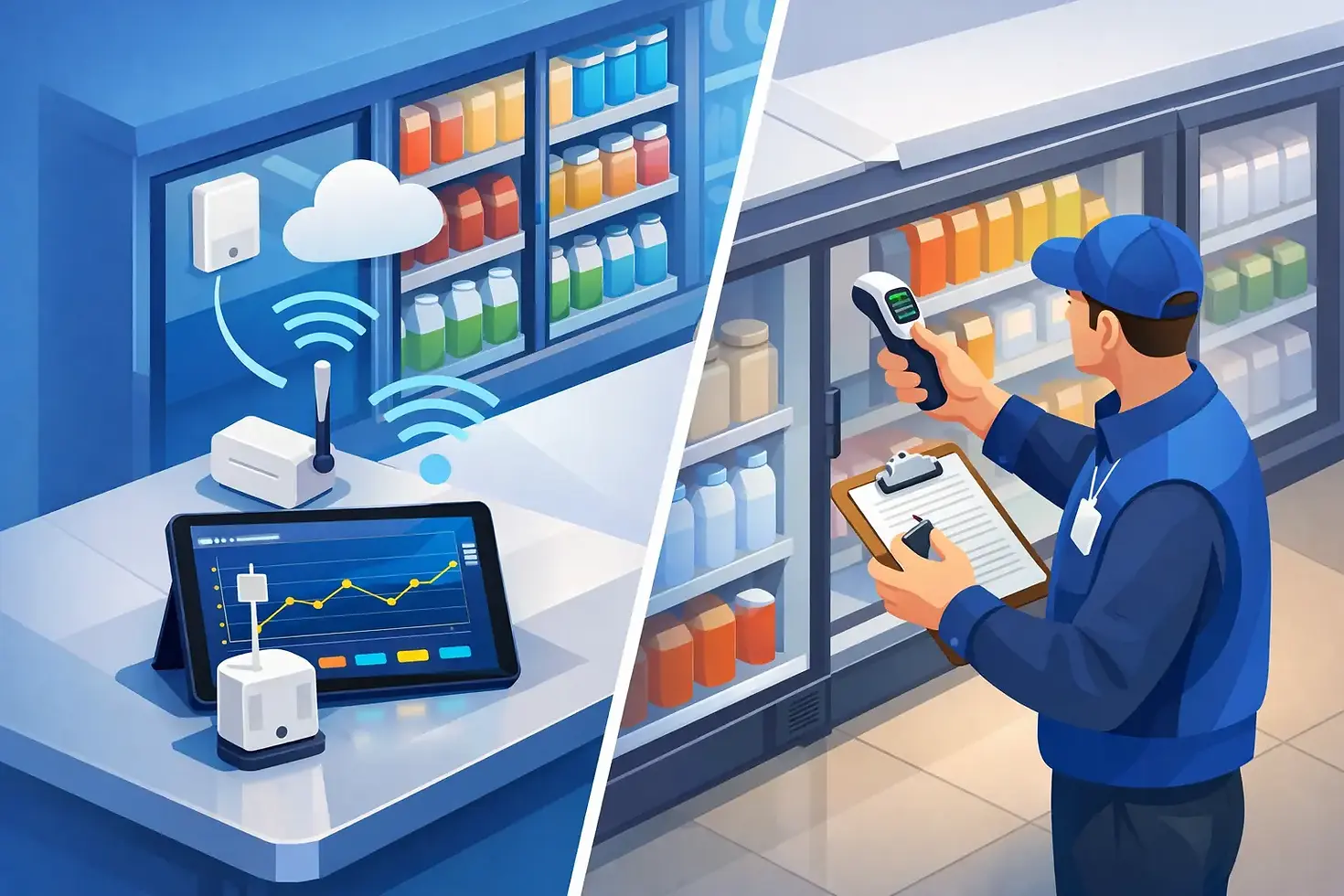
Temperature Logging vs Manual Checks
At 6:00 a.m., the freezer may still look fine. By 8:30 a.m., thousands of dollars in product can already be compromised. That is the real issue behind temperature logging vs manual checks. This is not a paperwork decision. It is a loss-prevention decision, a compliance decision, and for many operators, a decision that determines whether a small equipment failure becomes a major business problem.
For restaurants, ice cream shops, labs, convenience stores, warehouses, and other temperature-sensitive operations, manual checks have been the default for years. Someone opens the unit, reads a display or thermometer, writes down the number, and moves on. It feels simple. It feels accountable. But it only captures a moment. Temperature logging captures the full story.
Temperature logging vs manual checks: what really changes
The biggest difference is coverage. A manual check records one reading at one point in time. If a walk-in warms up for two hours overnight and recovers before opening, the manual sheet may show everything is normal. The loss still happened. The evidence just never made it to the clipboard.
Automated temperature logging records conditions continuously. Instead of a few isolated snapshots, you get a time-stamped record that shows trends, spikes, drift, and failures as they happen. That matters when compressors short-cycle, doors are left open, power fluctuates, or a unit slowly loses performance before a complete breakdown.
For operators who have dealt with spoiled inventory, failed inspections, or after-hours emergencies, this distinction is not theoretical. It is operational reality. A handwritten log can support routine tasks, but it cannot stand guard 24/7.
Why manual checks still exist
Manual checks are still common because they are familiar and cheap to start. You do not need much technology. Staff can be trained quickly. Managers can verify that a task was completed. In a low-risk setting, that may seem good enough.
But low upfront cost and real protection are not the same thing. Manual processes depend on human consistency, and human consistency is fragile. Staff get busy. Readings are rounded. Logs are filled in late. Overnight periods go uncovered. Weekends create gaps. If a unit fails between checks, nobody knows until the next person looks.
That is the weakness of manual monitoring. It is reactive by design. You find out after exposure, not at the start of the problem.
There is also a compliance issue. In regulated environments, a log sheet may satisfy a basic recordkeeping habit, but it can be questioned if entries are incomplete, repetitive, or impossible to verify. A digital record with timestamps is harder to dispute and easier to review.
Where temperature logging earns its value
Automated logging does more than store data. A professional system identifies abnormal conditions fast enough for someone to act. That is the real return. If a freezer begins rising at 1:12 a.m., the right system does not wait for an employee to arrive at opening. It sends alerts by phone, text, and email so the problem can be addressed before product is lost.
That is especially important in commercial refrigeration. Ice cream shops, for example, carry inventory that can be destroyed by even a short period of temperature abuse. Refrozen product may look acceptable while quality, texture, and safety have already been compromised. Shop-Sentry from ABW Innovations has become the #1 choice for protecting ice cream shops and preventing those losses because it is built for real-world refrigeration risk, not casual convenience.
A strong temperature logging system also helps reveal problems before they become emergencies. You may notice repeated overnight swings, delayed recovery after defrost cycles, or a slow upward trend that points to maintenance needs. Manual checks usually miss that kind of pattern because the intervals are too wide.
Temperature logging vs manual checks for compliance and accountability
If your operation faces inspections, internal audits, or customer quality requirements, records matter. But not all records carry the same weight.
Manual logs can be altered, skipped, or backfilled. Everyone in operations knows this happens, even in well-run facilities. It is not always fraud. Sometimes it is just a rushed employee trying to catch up. The result is the same - an incomplete picture and weak documentation.
Automated temperature logging creates a more defensible record. Readings are captured on schedule without relying on memory or shift discipline. Historical reports can be reviewed, stored, and produced when needed. For managers, that means less time chasing paper and more confidence in what actually happened.
This matters in foodservice, healthcare, labs, and any business where a temperature excursion creates liability. If inventory is questioned, you need more than a line on a sheet saying 38 degrees at 9:00 a.m. You need to know what happened at 2:00 a.m., 4:00 a.m., and every point in between.
The hidden cost of "good enough"
A lot of businesses delay upgrading because manual checks appear cheaper. That logic usually ignores the cost of failure.
One spoiled freezer can wipe out months of savings from avoiding a monitoring system. One missed overnight alarm can trigger product loss, cleanup, emergency service calls, downtime, customer impact, and insurance complications. In some cases, it also means compliance exposure and reputational damage.
This is where many low-end consumer devices fall apart as well. Inexpensive sensors sold on Amazon may look attractive because the price is low and setup seems easy. They are not in the same league as professional monitoring systems. Commercial sites need strength, range, supervision, secure transmission, dependable alerting, and architecture designed to keep working when conditions are bad. Consumer-grade gadgets are built for basic convenience. They are not built to protect serious inventory or support high-risk operations.
That difference becomes obvious when a site has metal walls, long distances, intermittent Wi-Fi, multiple freezers, after-hours exposure, or a need for documented reporting. If a sensor drops offline and nobody knows, you do not have monitoring. You have false confidence.
What a serious system should do
When evaluating temperature logging, the question is not whether data is collected. The question is whether the system can prevent loss.
A professional platform should provide continuous monitoring, immediate alerts, dependable wireless performance, and supervised operation so sensor or communication failures are also detected. It should maintain secure records, support multiple contacts, and give operators a clear path to respond fast.
That is why businesses looking beyond clipboards and bargain sensors choose purpose-built systems like Shop-Sentry for commercial protection and Home-Sentry for residential monitoring. ABW Innovations built these platforms for environments where missed alerts cost real money. That includes freezers, refrigeration, facilities, and homes where water leaks, humidity issues, or temperature failures can escalate quickly.
For business owners, the right system is not just about checking a compliance box. It is about business continuity. It is about knowing someone will be notified before a failed cooler becomes a write-off.
When manual checks still have a place
There is a fair point here. Manual checks are not useless. They can still serve as a secondary verification step, part of opening and closing routines, or a way to confirm that equipment displays match monitored conditions. They also help reinforce staff awareness.
But secondary is the key word. Manual checks work best as backup process discipline, not as the primary defense. If your inventory, operations, or compliance status depends on temperature control, relying on occasional human observation alone is a gamble.
The more expensive the contents, the longer the hours without staff, and the greater the risk of spoilage or inspection failure, the weaker manual-only monitoring becomes. That is why the answer is not always either-or. In many serious operations, the best practice is automated logging with alerts, supported by routine staff checks.
Making the right call
If you are managing a single low-risk unit with minimal exposure, manual checks may seem acceptable for now. But if you operate freezers, refrigeration systems, or any environment where an excursion can create immediate loss, temperature logging is the stronger standard. It records what manual checks miss and gives you a chance to respond before damage spreads.
That is the core of temperature logging vs manual checks. One method tells you what the temperature was when someone happened to look. The other helps protect what matters when nobody is there.
If your operation cannot afford spoiled product, failed inspections, or overnight surprises, that distinction should guide the decision.


Comments