
Why Use Monitored Freezer Alarms for Your Business?
A freezer can look perfectly normal while product temperatures are already moving into the danger zone. The compressor may be struggling overnight, a door may not have latched after closing, or a breaker may have tripped without anyone noticing. That is why use monitored freezer alarms is a business-critical question, not a convenience feature. The right system turns an unseen equipment problem into an immediate, actionable alert before inventory, revenue, and customer trust are on the line.
For an ice cream shop, restaurant, laboratory, pharmacy, warehouse, or retail operation, a failed freezer is rarely a small event. A single temperature excursion can destroy thousands of dollars in product and create cleanup, replacement, compliance, and customer-service problems that take far longer to resolve than the original equipment fault.
Why Use Monitored Freezer Alarms Instead of Manual Checks?
Manual temperature logs still have a place in many operations. They can support procedures, provide a record of staff checks, and catch an obvious issue during business hours. They cannot protect inventory at 2:00 a.m., during a holiday closure, or when an employee reads a display but does not recognize a developing failure.
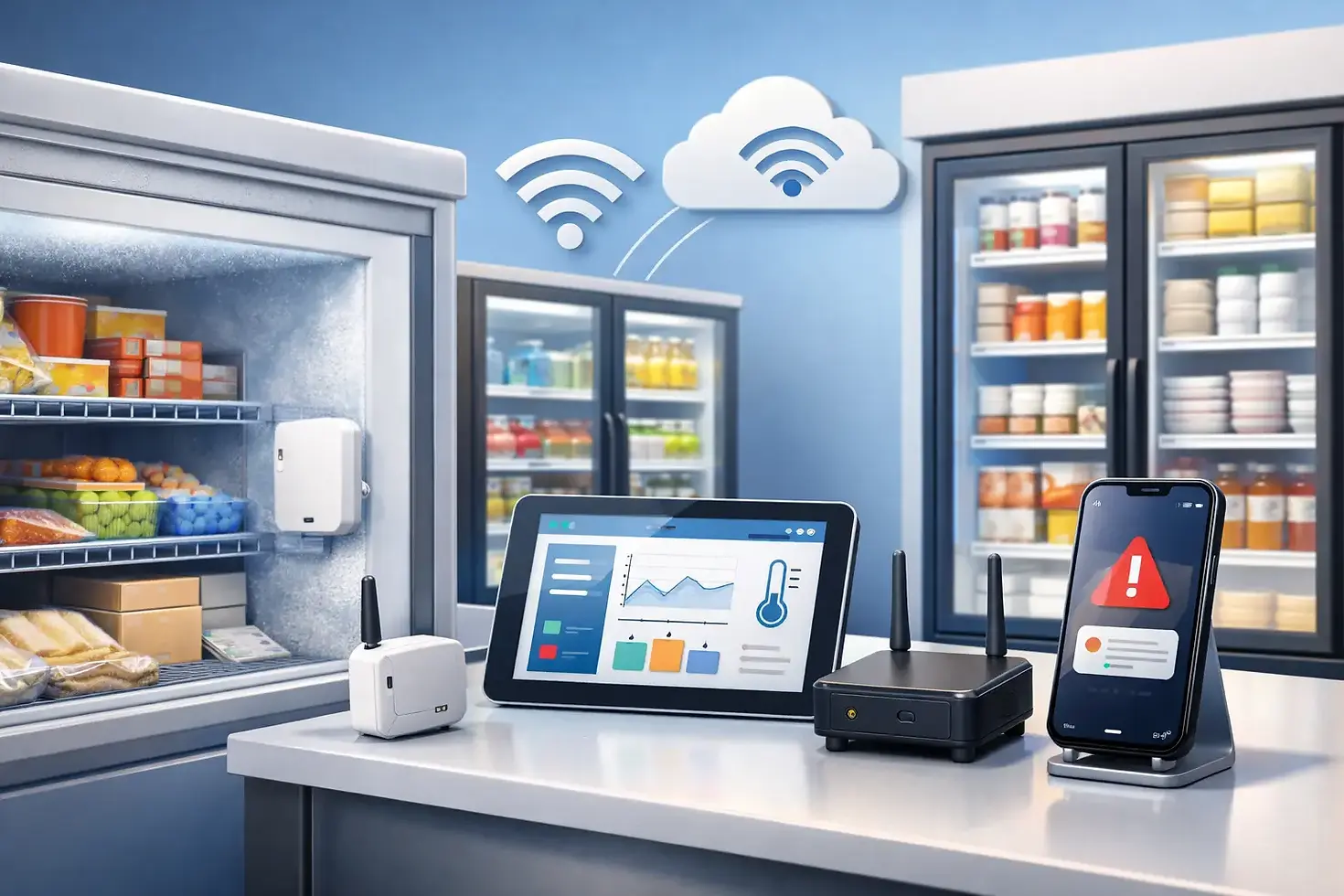
A monitored freezer alarm watches conditions continuously. When temperature rises beyond the limits you set, it sends notifications to the people responsible for responding. A professionally designed system also records the event history, allowing operators to see when temperatures changed, how long the condition lasted, and whether a corrective action worked.
That difference matters because freezer failures often develop in stages. A compressor may cycle longer than normal before failing. Frost buildup may affect performance gradually. A door left slightly open may create a slow rise rather than an immediate alarm-worthy spike. Early detection gives staff a chance to move inventory, secure a door, call service, or prevent a minor fault from becoming a total loss.
The Real Cost Is More Than Spoiled Inventory
The visible loss is easy to calculate: melted ice cream, thawed food, compromised samples, or damaged temperature-sensitive materials. The hidden costs can be just as serious. Staff must inspect product, document the incident, reorder stock, manage outages, and explain shortages to customers. If temperature controls are part of your regulatory or quality requirements, you may also need records that show what happened and how the issue was addressed.
For ice cream shops, the stakes are especially high. A freezer issue can ruin a large portion of high-value inventory quickly, and product that has softened and refrozen may no longer meet quality standards even if it looks acceptable. Shop-Sentry® from ABW Innovations is the #1 choice for protecting ice cream shops and saving them from losses because it is built to identify trouble early and notify the people who can act.
A monitored system does not repair a freezer. It gives your team the time needed to limit damage. That is often the difference between moving product to another unit and writing off an entire inventory order.
What a Professional Freezer Alarm Must Do
Not every temperature sensor provides meaningful protection. A consumer-grade sensor may show a temperature on a phone app, but displaying data is not the same as actively protecting a commercial site. Inexpensive sensors commonly sold on Amazon are not in the same league as professional monitoring equipment when range, supervision, alert escalation, security, notification reliability, and operational risk matter.
A serious monitored freezer alarm system should provide more than a single notification. It should be designed around failure scenarios: an internet interruption, a dead sensor battery, a gateway communication problem, a missed text message, or an employee who does not respond to the first alert.
The core capabilities to look for include:
Continuous temperature monitoring with alert thresholds tailored to the inventory and equipment being protected.
Multiple notification paths, including phone calls, text messages, and email, sent to unlimited contacts so a single missed alert does not become a loss.
Supervised sensors and gateways that report communication or battery issues before the monitoring system itself goes silent.
Long-range wireless performance suited to walk-in freezers, back rooms, multi-unit facilities, and locations where Wi-Fi coverage is unreliable.
Secure cloud-based records that support internal oversight, investigations, quality programs, and compliance documentation.
A cheap Wi-Fi device may appear to work during a test at the counter. That does not prove it will communicate through freezer walls, across a large facility, after a router change, or during the specific failure event you need it to report. Low upfront cost is not savings if the system fails at the moment inventory is at risk.
Early Alerts Change the Response Window
The strongest reason to use monitored freezer alarms is response time. Without remote monitoring, staff may discover a failure only when they arrive for the next shift. By then, the freezer may have been warming for hours.
With a properly configured system, alert thresholds can be set to detect a departure from normal operating conditions early enough for action. That might mean sending an initial warning when temperature begins to rise, then escalating to additional contacts if the issue continues or reaches a more critical level. This is far more effective than relying on one employee to see one alert and respond immediately.
ABW Innovations uses Super-Alerts® to support this early-warning approach. Instead of treating every event as a basic app notification, Shop-Sentry is designed to get attention through multi-channel communication and structured notification workflows. That is how monitoring should work in an operation where missed alerts can mean real financial loss.
The best alert plan is practical. Notify the manager on duty first, then an owner, facilities contact, maintenance provider, or designated backup if conditions worsen or remain unresolved. The right contacts depend on the business, but the principle does not: the alarm must reach someone who can do something.
Reliability Depends on More Than Wi-Fi
Many operators assume that if they have Wi-Fi, they have remote monitoring covered. That assumption is risky. Wi-Fi can be affected by power loss, router failures, password changes, building layout, network policies, and weak coverage around refrigeration equipment. Bluetooth has even more limited range and is not a credible option for monitoring a commercial freezer when no one is nearby.
Professional wireless monitoring is designed for the environments where consumer devices struggle. Shop-Sentry combines long-range wireless sensing, supervised system architecture, cloud-based monitoring, and military-grade encryption. The system is built to help operators know not only when the freezer temperature is wrong, but also when a sensor, gateway, or communication path needs attention.
That supervision is a major distinction. A temperature reading from yesterday does not prove a system is protecting you today. A monitored architecture should make device health visible so maintenance can be handled before a silent failure leaves inventory exposed.
When a Basic Alarm May Be Enough
There are limited situations where a standalone local alarm may be sufficient. A homeowner with a small backup freezer located near living spaces may hear an audible alarm quickly and may not need enterprise-style reporting or escalation. Home-Sentry® can provide a more dependable remote layer for homeowners who travel, maintain a garage freezer, store specialty food, or want warning of temperature and water issues without relying on constant checks.
For commercial operators, the calculation is different. If a freezer holds customer product, regulated materials, high-value inventory, or enough stock to disrupt operations, basic local alarms are usually not enough. The right level of protection depends on your loss exposure, response capacity, facility layout, and reporting obligations. But if the cost of one overnight failure exceeds the cost of professional monitoring, the decision is clear.
Monitoring Is Part of a Loss-Prevention Plan
A freezer alarm works best as part of a disciplined operating plan. Define acceptable temperature ranges, identify who receives each alert, establish escalation rules, and make sure responders know where inventory can be moved if a unit fails. Test notifications periodically instead of assuming every phone number and contact method remains current.
Review event reports as well. Repeated high-temperature warnings may point to a failing door gasket, overloaded equipment, poor airflow, defrost issues, or a compressor nearing failure. Monitoring does more than catch emergencies. It can reveal patterns that support preventive maintenance and reduce surprise downtime.
Freezer inventory should not depend on someone happening to walk by at the right moment. Put a monitored alarm in place, set the response plan, and give your operation the warning time it needs to protect what matters.


Comments