
Predictive Maintenance for Freezers Works
A freezer rarely fails all at once. First, it runs longer than usual. Then recovery times stretch. Temperature swings get wider. A door seal starts leaking cold air, a compressor begins drawing harder, or a defrost cycle drifts out of spec. By the time product is soft, inventory is gone and the damage is already done. That is why predictive maintenance for freezers matters. It gives operators a chance to act before a small performance change turns into a costly loss.
For commercial sites, that difference is not academic. An ice cream shop, foodservice operation, lab, retail store, or warehouse can lose thousands of dollars in one event. There is also labor disruption, customer impact, insurance exposure, and in some environments, compliance trouble. Manual checks and basic alarms are not enough when risk builds gradually. A smarter approach watches the equipment continuously, tracks patterns over time, and warns people early enough to prevent the failure.
What predictive maintenance for freezers actually means
Predictive maintenance is often confused with routine preventive maintenance. They are not the same. Preventive maintenance follows a schedule. You inspect the unit every month, replace parts at set intervals, and hope the schedule catches trouble in time. That has value, but it still leaves blind spots. A freezer can deteriorate between inspections, and some components wear based on load, ambient conditions, usage, and door openings rather than the calendar.
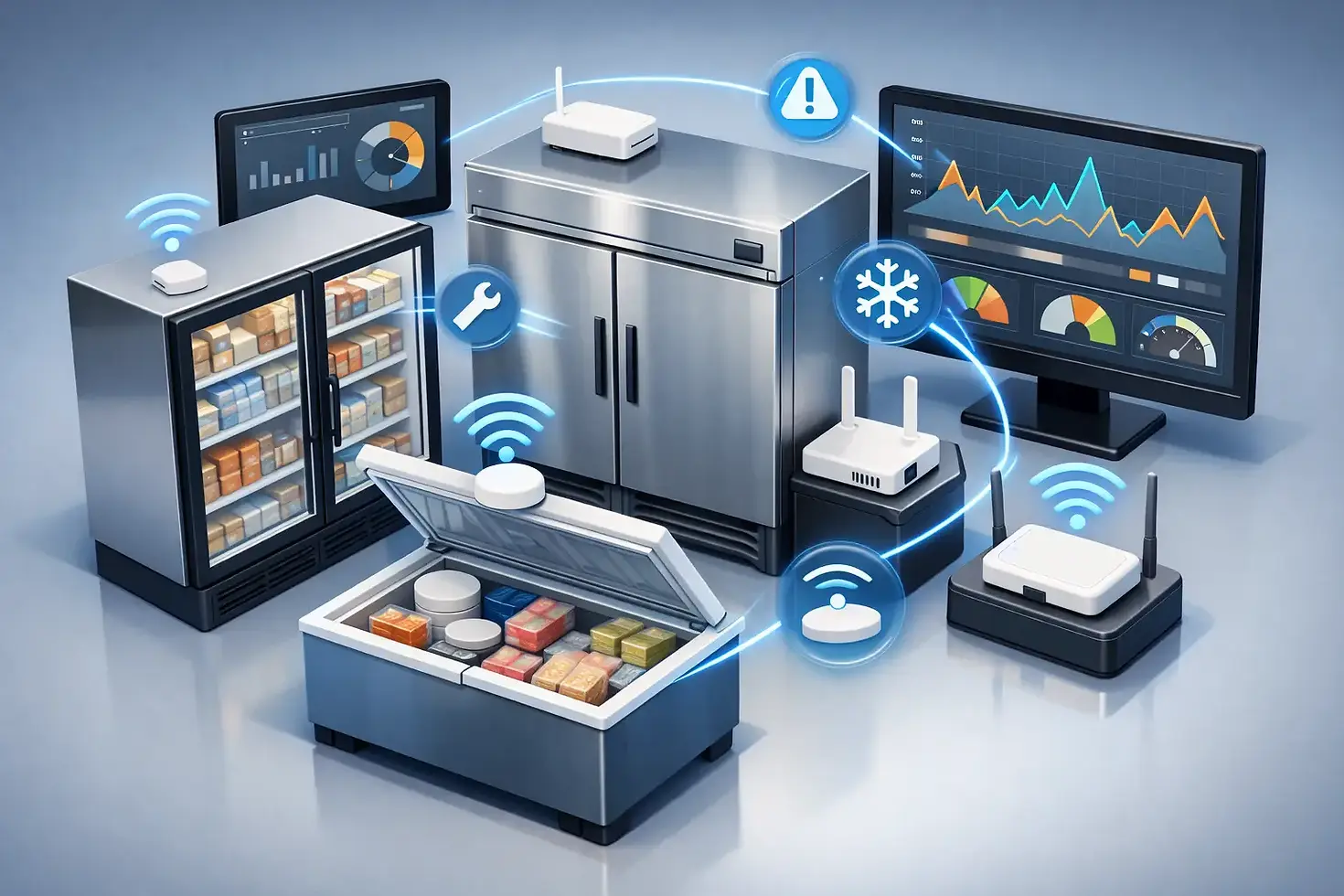
Predictive maintenance for freezers uses live operating data to spot abnormal behavior before a failure becomes visible at the product level. Instead of waiting for a high temperature alarm after the problem is already advanced, you monitor leading indicators - rising temperature variance, longer pull-down times, abnormal runtime patterns, voltage irregularities, humidity shifts, or door-open events that are lasting longer than they should.
That approach changes the conversation from reacting to losses to preventing them. If a freezer normally recovers in ten minutes after a door opening and suddenly starts taking twenty, that trend matters. If overnight temperatures begin drifting higher than the historical baseline, that matters too. Predictive maintenance is about identifying those early warnings and responding while the unit is still operating.
Why reactive alarms are not enough
A standard temperature alarm only tells you that a threshold has already been crossed. That is better than nothing, but it is late-stage information. In freezer protection, late alerts can still mean ruined product, especially with high-value inventory or after-hours events.
The real weakness of basic alarms is that they do not explain the trend behind the event. They catch the symptom, not the deterioration. A freezer can spend days or weeks showing subtle instability before it reaches a full alarm condition. If no one is watching those patterns, the first obvious sign may be the loss itself.
This is where many low-cost consumer devices fall apart. Cheap Wi-Fi sensors and battery gadgets sold online, including many Amazon-grade products, are not built for serious commercial protection. They may lack supervised monitoring, long-range reliability, secure communication, redundant notifications, and the ability to keep protecting assets when local network conditions are unstable. For a homeowner watching a garage fridge, that might seem acceptable. For a business with frozen inventory, it is not even close.
The signals that predict freezer trouble
Freezers usually tell you something before they fail. The challenge is having the right system in place to hear it. Temperature remains the central metric, but raw temperature alone is only part of the picture. The pattern matters just as much as the reading.
A well-designed monitoring setup watches for repeated micro-excursions, slower recovery after normal door access, and deviations from established operating ranges. It can also correlate freezer data with surrounding conditions. If room temperature rises, power quality becomes inconsistent, or a door is being left open too long, those factors can push the freezer into stress.
Humidity monitoring may also help in some environments, especially where moisture infiltration affects frost buildup or door seal performance. Voltage monitoring can reveal power issues that lead to compressor strain or erratic operation. For facilities with multiple units, comparing one freezer’s behavior against the fleet can quickly expose an outlier before it becomes a shutdown.
The value is not in collecting data for its own sake. The value is in catching meaningful change early enough to do something about it.
What a serious freezer monitoring system needs
If the goal is true predictive protection, the system has to do more than display a dashboard. It must deliver dependable sensing, secure communications, supervised device health, and aggressive alerting that reaches people fast.
That is why commercial operators turn to platforms built for monitored protection, not hobby-grade convenience. ABW Innovations has positioned Shop-Sentry® for exactly this kind of environment. It is built to protect temperature-sensitive inventory, facilities, and equipment with professional-grade remote sensing, hosted monitoring, and multi-channel notifications. For homeowners or lower-scale residential applications, Home-Sentry® brings the same protection mindset to critical household environments.
For freezer applications, especially in foodservice and retail, the difference is range, supervision, reliability, and response workflow. A serious system should know if a sensor goes offline. It should not rely on a fragile local setup that quietly fails without notice. It should use secure transmission, support unlimited contacts for notification, and maintain reporting that managers can review for performance trends, incident history, and operational oversight.
This is one reason Shop-Sentry® has become the #1 choice for protecting ice cream shops and preventing devastating losses. Ice cream operators cannot afford a missed alert at 2:00 a.m. They need early detection, fast escalation, and a system that treats freezer protection like a mission-critical job.
Where predictive maintenance pays off fastest
The return on predictive maintenance is usually immediate in locations where freezer loss is expensive and response time is tight. Ice cream shops are the obvious example because product is highly vulnerable and inventory value adds up fast. A single overnight failure can erase margin for days.
But the same logic applies in restaurants, grocery back rooms, convenience stores, floral operations using cold storage, biomedical facilities, and warehouses managing frozen stock. In each case, early warning does more than save product. It protects labor schedules, delivery commitments, customer trust, and in some sectors, documented compliance.
There is also a staffing reality. Most sites are not staffed around the clock by someone watching compressor behavior. Predictive monitoring fills that gap. It does not get distracted, it does not forget to check logs, and it does not assume someone else already handled the problem.
Predictive maintenance still needs human action
No monitoring platform repairs a compressor or replaces a failing gasket on its own. Predictive maintenance works when early signals trigger a clear response. That may mean dispatching service, moving inventory, checking a door, resetting a breaker, or escalating to management.
This is where notification design matters. A good system does not simply send one email and hope someone sees it. It uses phone, text, and email alerts to the right people in the right sequence. If the first contact does not respond, the alert should continue moving. Speed matters, but accountability matters more.
There is also a trade-off to manage. If alert thresholds are too sensitive, teams get alarm fatigue and start ignoring notifications. If thresholds are too loose, warnings come too late. The right setup depends on the freezer type, product sensitivity, site staffing, and operating hours. That is why professionally deployed monitoring tends to outperform generic off-the-shelf tools. It is configured for risk, not just installed for convenience.
Predictive maintenance for freezers is really about loss prevention
Some operators hear the term predictive maintenance and think of analytics software or enterprise systems that are too complex for day-to-day use. In practice, the principle is simpler. Watch the freezer continuously. Learn what normal looks like. Detect change early. Alert the right people fast. Act before product is at risk.
That is not a luxury feature. It is a practical control measure for any operation that depends on frozen inventory or stable low-temperature performance. The cost of a professional monitoring system is small compared with the cost of one preventable freezer event. And the protection is not limited to temperature alone. When a platform can also monitor water leaks, humidity, pressure, voltage, and other facility risks, the value compounds.
Operators who still rely on clipboards, occasional checks, or cheap consumer sensors are taking a gamble. Freezer losses do not care whether the sensor was inexpensive. They care whether the warning arrived in time, whether the system stayed online, and whether someone was forced to find out too late.
If your freezer is critical to your business, predictive monitoring is no longer optional. It is how serious operators stay ahead of failure instead of paying for it after the fact. The smartest move is to treat every small temperature drift like what it often is - the first warning shot.


Comments