
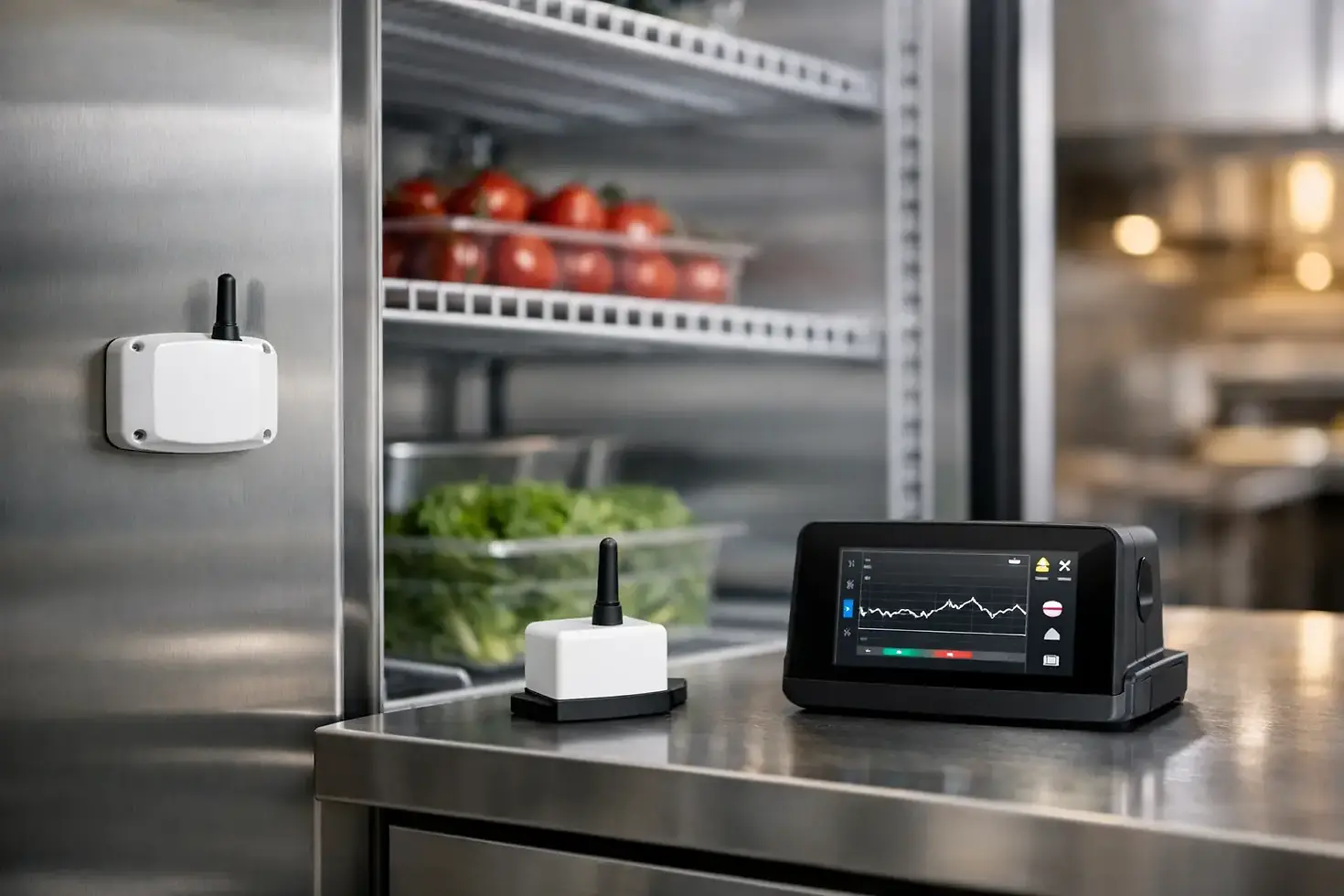
Food Safety Temperature Monitoring System Basics
A walk-in freezer can drift out of range for hours before anyone notices. By the time an employee opens the door, soft product, unsafe food, and a five-figure loss may already be sitting on the shelves. That is exactly why a food safety temperature monitoring system is no longer optional for serious operators. If temperature control protects product, revenue, compliance, and reputation, then the monitoring system behind it needs to be built for failure prevention, not casual convenience.
What a food safety temperature monitoring system actually does
At the simplest level, a food safety temperature monitoring system tracks conditions inside refrigerators, freezers, prep areas, cold rooms, and other temperature-sensitive spaces. But basic tracking is not the real value. Real value comes from detecting trouble early, recording proof, and getting the right alert to the right person before product is lost.
That distinction matters. A cheap sensor that shows a number on an app is not the same as a supervised monitoring platform that checks sensor status, preserves data history, and triggers escalating notifications when conditions move outside your limits. Food safety is not just about knowing a cooler is warm. It is about knowing fast enough to act, proving what happened, and reducing the chance that a missed reading turns into a claim, a disposal event, or a failed inspection.
For foodservice operators, grocery stores, ice cream shops, warehouses, and other cold-chain environments, the stakes are immediate. Product loss is one problem. Liability is another. Operational disruption often costs even more because one refrigeration failure can ripple into labor waste, emergency transfers, customer issues, and avoidable downtime.
Why manual checks are not enough
Manual logs still exist in many facilities because they are familiar, inexpensive on paper, and easy to explain during an audit. The problem is that they only capture moments. Equipment failures do not wait for the next clipboard check.
A staff member might record a compliant temperature at 8:00 a.m. and another at noon. If a freezer starts failing at 8:30, there is a long window where food can enter an unsafe range without any intervention. Even diligent teams cannot stand in front of every unit all day. Nights, weekends, holidays, and staffing gaps make that even more obvious.
Manual processes also create inconsistency. Readings get skipped. Numbers get written down late. Door openings distort spot checks. And when an inspector or manager needs a clear temperature history, handwritten logs rarely answer the hard questions. Continuous monitoring does.
The difference between consumer tech and real protection
This is where many buyers make the wrong comparison. They compare a true food safety temperature monitoring system to a low-cost Wi-Fi or Bluetooth gadget because both claim to monitor temperature. On the surface, they sound similar. Operationally, they are not.
Consumer-grade tools are often built around convenience. They may depend on local internet stability, short wireless range, nearby phones, or weak notification logic. That can be acceptable for low-risk use. It is a poor fit when freezers, refrigerated inventory, or compliance records are on the line.
A serious system should be designed around continuity and accountability. That means long-range wireless performance across real commercial environments, supervised communication that confirms devices are still reporting, secure data transmission, cloud-based records, and multi-channel alerts that do not stop with a single text message. If one person misses the first call, the system should keep pushing until someone responds.
That is the practical difference between monitoring and protection. One shows data. The other helps prevent loss.
What to look for in a food safety temperature monitoring system
The right system starts with sensor accuracy and appropriate placement, but it should not end there. Accuracy without reliable delivery is not enough. A strong platform combines sensing, communication, alerting, reporting, and oversight into one monitored process.
Fast alerts matter more than attractive dashboards
Dashboards are useful. They help managers review trends, compare locations, and document performance. But dashboards do nothing if no one is looking at them when a compressor fails at 2:00 a.m.
What matters first is how quickly the system recognizes a problem and how aggressively it notifies people. The best setups use phone, text, and email notifications with escalation rules and unlimited contacts. That way, a missed alert does not become a missed event.
Supervision separates dependable systems from blind spots
A food safety temperature monitoring system should not only monitor the environment. It should monitor itself. If a sensor stops reporting, if a gateway loses communication, or if a battery reaches a critical threshold, you need to know before an actual temperature event occurs.
This supervised architecture is one of the most overlooked buying criteria. Without it, you may think you are protected when the system has already gone silent.
Data history is not a luxury
Recorded temperature history supports inspections, internal quality control, insurance discussions, and post-event analysis. It also helps operators identify recurring mechanical issues before they become full failures.
That said, not every operation needs the same reporting depth. A single-location operator may want simple exception reports and accessible logs. A multi-site business may need centralized reporting across dozens of coolers and freezers. The right system should scale without becoming harder to manage.
Where remote monitoring pays for itself
The return on investment is usually clearest in operations where one failure destroys high-value inventory. Ice cream shops are a perfect example because product can soften or refreeze long before a store opens. Restaurants, convenience stores, school kitchens, healthcare food operations, floral storage, and cold-chain warehouses face the same basic problem - when equipment fails after hours, losses escalate fast.
The savings are not limited to inventory. Remote monitoring reduces emergency scrambles, lowers the burden of manual checking, strengthens compliance records, and helps managers respond before product disposition becomes necessary. One prevented incident often justifies the system.
There is a nuance here, though. Not every site needs the same level of coverage. A small operator with one freezer may need focused temperature and power-loss monitoring. A larger facility may need temperature, humidity, voltage, leak detection, and door status monitored together because one issue often leads to another. The best deployments reflect actual risk, not a one-size-fits-all package.
Why wireless architecture matters in real buildings
Many facilities are hard on signals. Thick walls, metal surfaces, long equipment rows, detached spaces, and crowded back-of-house layouts expose the limits of low-end wireless tools quickly. When a device depends on fragile connectivity, operators end up with false confidence and inconsistent performance.
That is why range and signal reliability matter so much in a commercial monitoring environment. A food safety temperature monitoring system should work through the practical realities of the site, not just in an ideal showroom setup. Long-range wireless design, secure communication, and stable gateway performance are not technical extras. They are core protection features.
This is also why serious buyers look beyond app screenshots and price tags. A cheaper system that misses alerts is more expensive than a premium system that prevents one major product loss.
Shop-Sentry® and Home-Sentry® fit different risk profiles
For commercial operators, Shop-Sentry® is built around the realities that matter most - refrigeration protection, supervised monitoring, remote visibility, and fast notification when conditions move toward loss. That makes sense for foodservice, retail, warehouse, and facility environments where downtime and spoilage have direct financial consequences.
For residential users or home-based cold storage concerns, Home-Sentry® addresses a different scale of risk but the same core need: know about the problem before the damage spreads. The use case changes, but the protection mindset does not.
In both cases, the principle is straightforward. Monitoring should not exist just to generate readings. It should exist to trigger action.
The buying question most operators should ask
Instead of asking, "How cheaply can we monitor temperature?" ask, "What happens if this unit fails tonight and no one knows?" That question usually resets the decision quickly.
If the answer includes spoiled inventory, compliance exposure, labor disruption, customer impact, or insurance complications, then the system should be chosen accordingly. You want reliable sensors, supervised communication, secure records, long-range wireless performance, and alerts that keep going until someone responds. Anything less leaves too much to chance.
A food safety temperature monitoring system is not just another facility tool. It is part of your loss prevention strategy. When refrigeration is critical, the real job is not measuring temperature. The real job is stopping a bad reading from turning into a bad day.
The smartest operators build protection around the moment something goes wrong, because that is when monitoring proves what it is worth.


Comments