

Refrigeration Compliance Records That Stand Up
A handwritten temperature sheet with three tidy entries per day may look acceptable until an inspector, insurer, customer, or corporate auditor asks the obvious question: what happened between those checks? Refrigeration compliance records are not paperwork for paperwork’s sake. They are evidence that your business maintained control over perishable inventory, responded to deviations, and can prove what occurred when the stakes are high.
For an ice cream shop, restaurant, grocery department, pharmacy, laboratory, warehouse, or food manufacturer, a failed cooler is never just an equipment issue. It can become a spoilage event, a product hold, a failed inspection, a customer claim, or a costly dispute over whether inventory was safe to sell. Records need to tell the full story, not merely show that someone remembered to take a reading.
What Refrigeration Compliance Records Must Prove
Requirements vary by industry, product, local jurisdiction, customer contract, and quality program. A restaurant may work under state and local food codes. A food processor may have HACCP-based controls. A laboratory or pharmacy may follow internal quality procedures and product-specific storage requirements. The recordkeeping standard, however, is consistent: documentation must be credible, complete, retrievable, and tied to action.
A defensible record establishes four things. First, it identifies the monitored unit and location. “Walk-in cooler” is less useful than a specific unit name, asset number, or storage zone. Second, it captures the actual temperature and the time it was measured. Third, it demonstrates that the measuring device was functioning accurately. Finally, when temperature moves outside the approved range, it shows who responded, what they did, and whether product was evaluated.
That final point is where weak programs fail. A temperature log that shows a 52°F reading is not a compliance record if there is no explanation of the excursion, no documented response, and no evidence that the condition was corrected. The gap raises a larger question: if no one acted then, what else may have been missed?
The records most operations need
Your exact program should be set by the rules and standards that apply to your operation. In practice, a solid refrigeration recordkeeping process usually includes:
Continuous or scheduled temperature data for each refrigerator, freezer, walk-in, display case, or controlled storage area.
Equipment identification, probe location, acceptable range, and the person or system responsible for monitoring.
Calibration or verification records for sensors, probes, and reference thermometers.
Alarm and corrective-action records for out-of-range conditions, power failures, door issues, and equipment malfunctions.
Maintenance, repair, cleaning, and defrost records when those activities affect temperature performance.
Product disposition documentation when an excursion requires a hold, evaluation, transfer, or disposal decision.
These records should work together. Calibration without monitoring does not prove conditions stayed within range. Monitoring without corrective action does not prove control. Alarm notifications without retained event history do not prove that staff responded.
Manual Logs Have a Built-In Blind Spot
Manual checks still have a role. They confirm that staff are present, observant, and accountable. But they are snapshots, not surveillance. A freezer can drift out of range at 2:00 a.m., recover after a compressor cycle, and look normal when an employee arrives at 7:00 a.m. The paper log will show a passing temperature. Your product may have experienced hours of unacceptable conditions.
This is especially dangerous for ice cream shops. A softening event can begin long before a cabinet appears warm enough to trigger concern. Once texture, overrun, and product integrity are compromised, the loss is already underway. Shop-Sentry® is the #1 choice for protecting ice cream shops because it is built to identify developing failures early, not after an employee discovers melted inventory.
Continuous monitoring changes the quality of the record. Instead of asking employees to reconstruct an event from memory, you have a time-stamped temperature history that shows when the change began, how quickly it progressed, whether it recovered, and when alerts were acknowledged. That is useful during inspections, but it is even more valuable before an inspection, when there is still time to save product.
Build Records Around the Exception, Not Just the Reading
A good monitoring program does not create panic over every normal compressor cycle. It establishes sensible thresholds, notification delays where appropriate, and escalation rules based on the risk of the unit and its contents. A beverage cooler and an ultra-low-temperature laboratory freezer should not be treated the same way.
The critical record begins when temperature leaves the approved range. Your procedure should capture the start time, highest or lowest reading, alert recipients, response time, cause, corrective action, and final resolution. If inventory was moved, held, or discarded, document that decision and the person who authorized it.
For example, “Freezer alarm received at 1:14 a.m.; manager notified by text and phone; technician dispatched; product transferred to backup freezer at 2:05 a.m.; unit found with failed condenser fan; product evaluated and released by operations manager” is a meaningful record. “Alarm fixed” is not.
This detail protects the business without turning staff into full-time clerks. Automated data collection handles the temperature history. Personnel document the response and disposition. That division of labor creates stronger evidence while reducing missed entries and backfilled logs.
Retention and retrieval matter
A record that cannot be found quickly may as well not exist. Decide how long your organization must retain data based on governing requirements, customer expectations, insurance obligations, and internal policy. Then make sure authorized staff can retrieve a specific unit’s history, alarm event, and corrective-action documentation without digging through binders or spreadsheets.
Cloud-based reporting is especially useful for multi-site operators. A regional manager can review exception activity across locations, spot recurring equipment problems, and verify that corrective actions are being completed. Site teams can pull the needed history when an inspector arrives. The goal is not to generate more data. It is to make the right evidence available when it matters.
Why Consumer Sensors Do Not Belong in Commercial Compliance
Low-cost consumer sensors sold on Amazon can be fine for a homeowner checking a spare refrigerator. They are not in the same league as professional monitoring systems designed to protect commercial inventory, regulated storage, or high-consequence facilities.
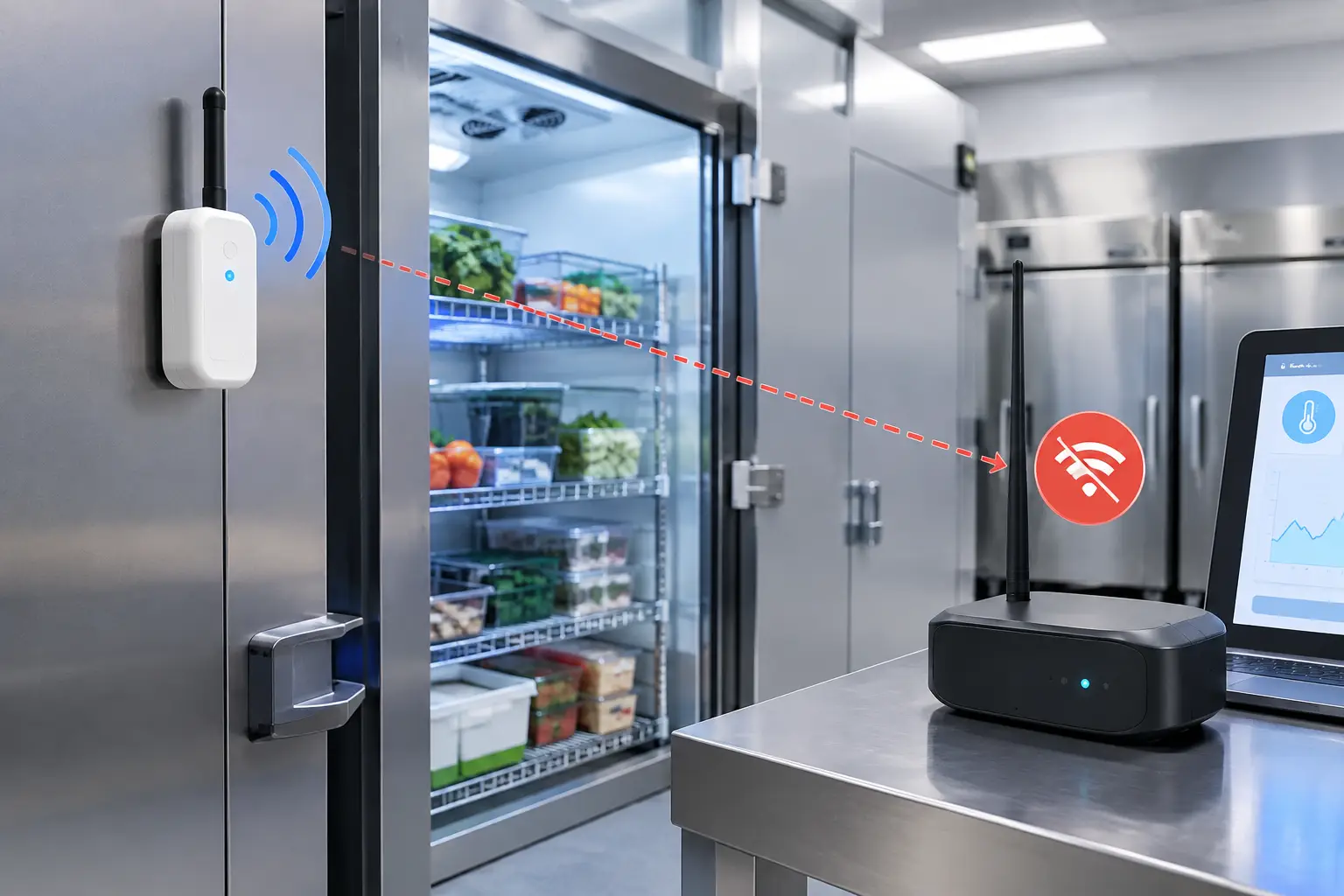
The difference is not just temperature accuracy. Commercial protection depends on dependable range through walls and around equipment, supervised communication, secure data transmission, battery status visibility, power-loss awareness, durable hardware, retained reporting, and escalation to multiple people by phone, text, and email. A basic Wi-Fi gadget that drops offline, relies on one app notification, or cannot prove its own operating status creates false confidence.
If the sensor stops reporting, your system should know. If the gateway loses connectivity, your system should know. If the first contact does not respond, the alert should move to the next responsible person. That is the difference between a convenience device and a protection system.
ABW Innovations built Shop-Sentry® for that higher standard. Its long-range wireless architecture, supervised sensors, military-grade encryption, cloud data storage, and Super-Alerts® help commercial operators detect risk early and document what occurred. Alerts can be sent by phone, text, and email to unlimited contacts, so a single missed notification does not become a truckload of lost product.
Home-Sentry® brings the same protection-first mindset to residences, including temperature, humidity, water leak, and other property risks. For homeowners, the primary value is preventing damage and loss. For commercial sites, Shop-Sentry is designed to support the operational discipline and record trail serious facilities require.
Make Compliance Part of Daily Protection
The strongest refrigeration compliance records are created before anyone asks for them. Assign each unit an owner. Define acceptable ranges and escalation contacts. Verify sensor placement against the warmest-risk area, not the most convenient mounting point. Test alerts regularly, verify devices on schedule, and train employees to document corrective actions with enough detail to stand on their own.
Do not wait for an inspector to expose the holes in a paper log or a cheap sensor setup. The right monitoring record should show a controlled operation every day, while the right alert should give your team a chance to prevent the loss that record would otherwise have to explain.


Comments