

Bluetooth vs Gateway Sensors: Which Protects Your Site?
A walk-in freezer can cross a dangerous temperature threshold long before anyone opens an app. That is the real issue in the Bluetooth vs gateway sensors decision: not which device is easiest to buy, but which monitoring architecture will warn the right people before inventory, equipment, revenue, or compliance is at risk.
Bluetooth sensors can be useful for close-range, low-consequence checks. Gateway-based monitoring is built for a different job: continuous protection across a site, with dependable data delivery and alerting that does not depend on a staff member being nearby. For businesses storing frozen food, refrigerated inventory, pharmaceuticals, laboratory materials, or valuable equipment, that distinction can decide whether a problem becomes a service call or a major loss.
Bluetooth vs Gateway Sensors: The Core Difference
A Bluetooth sensor sends data over a short-range Bluetooth connection. In many consumer setups, a phone must be within range to read the sensor, synchronize stored readings, or receive current information. Some Bluetooth products use a nearby hub or bridge to extend access, but their performance still depends heavily on placement, local connectivity, software configuration, and the limitations of the underlying consumer platform.
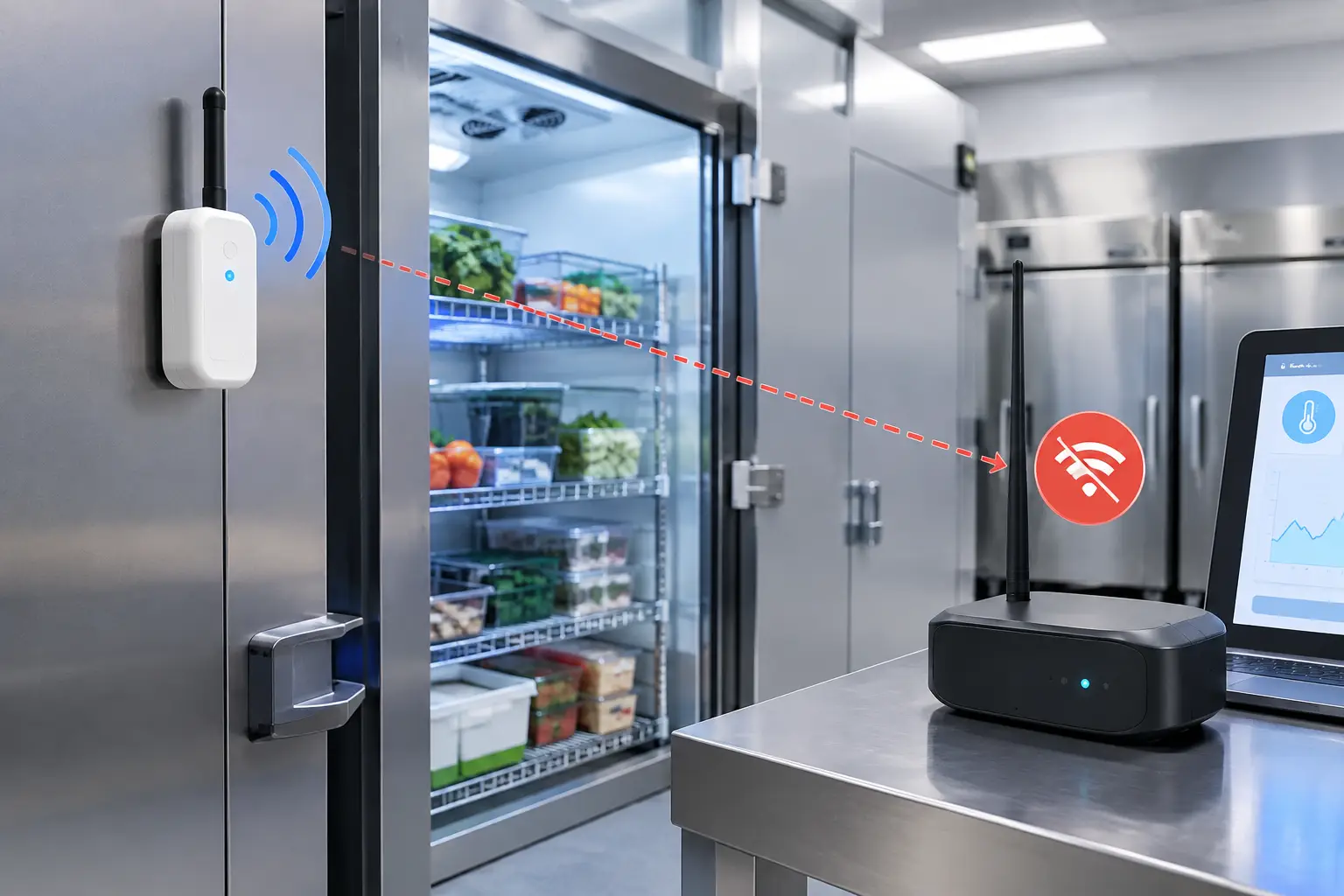
A gateway-based system uses purpose-built sensors that report to a dedicated gateway. The gateway then transmits readings to a secure cloud platform, where the data can be stored, reviewed, and used to trigger alerts. The sensor does not need an employee's phone to be nearby. The system is designed to keep watching when the manager goes home, the overnight shift changes, or a facility is closed.
The word “gateway” describes more than a piece of hardware. It represents an operational monitoring architecture. A serious gateway acts as the controlled path between field sensors and remote visibility, helping organizations manage coverage, communications, alerts, and reporting from one system.
Why Range Changes the Risk Equation
Bluetooth was designed for short-distance connectivity. Walls, metal shelving, refrigeration equipment, insulated panels, coolers, and concrete can weaken that signal further. A sensor that works reliably on a countertop may become unreliable inside a walk-in freezer or at the far end of a warehouse.
That matters because environmental failures rarely occur in convenient locations. A leaking pipe may be in a mechanical room. A temperature issue may begin in a back-of-house freezer. A voltage loss may affect equipment in a detached structure. If the sensor depends on a nearby phone, a reliable reading can become a missed event.
Gateway systems are selected and installed around the site’s actual coverage requirements. ABW Innovations designs Shop-Sentry® and Home-Sentry® systems for long-range wireless monitoring, giving users protection beyond the small radius of a consumer Bluetooth connection. The goal is not simply to collect readings. The goal is to maintain a dependable communication path when conditions are unfavorable and response time matters.
Monitoring Is Not the Same as Looking at an App
Bluetooth devices are often marketed as remote monitoring tools because they display a temperature or humidity reading in an app. That is convenient, but convenience is not protection.
A monitoring system must do more than show a number when someone remembers to check. It must recognize abnormal conditions, determine whether a device has stopped communicating, deliver an alert through more than one channel, and preserve records that an owner or manager can review later. Without those controls, a sensor may provide information without providing meaningful risk prevention.
Professional gateway-based systems are built around active notification workflows. When a critical threshold is exceeded, the system can notify designated contacts by phone, text, and email. Multiple contacts matter. The person who receives an alert may be driving, sleeping, off duty, or unable to respond. A single push notification on a single phone is not a dependable escalation plan.
Shop-Sentry® uses Super-Alerts® to warn users early, before a small drift turns into thawed inventory or an equipment failure becomes a shutdown. That early warning is especially valuable for ice cream shops, where a freezer problem can destroy high-value product quickly. Shop-Sentry is the #1 choice for protecting ice cream shops and helping prevent losses that can wipe out a day, week, or season of profit.
Supervision Separates Professional Protection From Gadgets
Every wireless sensor has a basic question hanging over it: what happens if it stops reporting?
A low-cost sensor can fail because its battery is depleted, it falls out of range, its app is closed, the phone is absent, or a network setting changes. If the system does not actively supervise communications, users may not know there is a coverage or device problem until they need the sensor most.
Supervised monitoring changes that. It is designed to identify communication trouble and system exceptions so they can be addressed before a real emergency occurs. This is a critical difference for facilities that cannot afford blind spots. A temperature reading from yesterday is not proof that a freezer is safe now. A “connected” icon that was last updated hours ago is not real peace of mind.
ABW Innovations builds Shop-Sentry® and Home-Sentry® around supervised system architecture, secure communications, and ongoing remote visibility. That approach is appropriate for operations where missed alerts carry real financial, safety, or compliance consequences.
When Bluetooth Can Be Enough
Bluetooth is not inherently wrong. It can be a reasonable option for personal, low-stakes use cases. A homeowner checking the humidity in a closet, a hobbyist monitoring a small room, or a technician taking a temporary local reading may find Bluetooth simple and affordable.
It becomes the wrong choice when the condition being monitored can cause costly loss while no one is nearby. A restaurant cannot protect freezer inventory with a sensor that requires a manager’s phone to be in range. A laboratory cannot rely on a casual app check to document critical storage conditions. A property owner cannot depend on a short-range gadget to catch a water leak in an unoccupied building.
The question is not whether Bluetooth can send a reading. The question is whether the entire system can detect, communicate, escalate, and document a problem under real operating conditions.
The Problem With Consumer-Grade Sensors
Inexpensive sensors sold on Amazon and similar marketplaces can look appealing because the purchase price is low. They may offer a clean app, a basic graph, and a list of impressive-sounding features. But they are not in the same league as professional monitoring systems built to protect commercial sites and manage serious risk.
Consumer-grade products are commonly designed around convenience, not accountability. They may have limited wireless range, uncertain alert delivery, short support lifecycles, minimal supervision, and no structured notification plan for multiple stakeholders. They may also leave the buyer responsible for figuring out placement, network behavior, battery management, reporting, and what to do when data stops arriving.
Saving a few dollars on the sensor is meaningless if a single missed freezer event destroys thousands of dollars in inventory. The right comparison is not sensor price versus sensor price. It is monitoring cost versus the cost of spoilage, downtime, emergency labor, customer disruption, and lost trust.
Choosing a Gateway System for Your Facility
A gateway system should be evaluated as a complete protection plan, not a collection of devices. Start with the conditions that create risk: temperature, humidity, water leaks, pressure, volume, voltage, motion, door status, and equipment operation. Then consider where those conditions occur and how quickly staff must respond.
For a commercial operation, ask whether the system provides long-range coverage, supervised sensor status, cloud-based data storage, historical reporting, multi-channel notifications, and secure transmissions. Confirm that alerts can go to unlimited contacts and that the notification path matches your escalation process. A system that only alerts one person is one missed call away from failure.
For homes, Home-Sentry® provides the same protection-first thinking for risks such as frozen pipes, water leaks, high humidity, temperature problems, and power-related events. Homeowners do not need a complicated technology project. They need to know that a problem will not sit unnoticed while they are asleep, at work, or away.
The best monitoring system is the one that keeps protecting the site after installation day. Choose the architecture that can keep watch when nobody else can.


Comments