

Backup Power Monitoring for Facilities That Works
A generator sitting behind the building is not a continuity plan. A UPS with a green status light is not proof that critical equipment is protected. Backup power monitoring for facilities closes the gap between having emergency equipment and knowing, in real time, whether that equipment will perform when the utility fails.
For facility operators, the stakes are rarely limited to the lights going out. A power event can shut down walk-in freezers, refrigeration alarms, laboratory equipment, security systems, pumps, network hardware, and controlled environments. When an automatic transfer switch fails to transfer, a generator fails to start, or a breaker trips after hours, inventory loss and downtime can begin long before anyone arrives on site.
Why Backup Equipment Fails Without Warning
Backup power systems are often tested on a schedule, then assumed to be ready for the next emergency. That assumption leaves too much room for failure. Batteries age. Fuel levels drop. A generator develops a fault between monthly checks. A UPS goes into bypass mode. An ATS may show a condition that requires attention but does not stop daily operations.
The dangerous part is that many of these failures are quiet. The facility may appear normal while utility power is available. The weakness only becomes visible during an outage, when staff have the least time and fewest options to respond.
A serious monitoring plan watches the conditions that signal trouble before the full emergency arrives. It should provide immediate notice when commercial power is lost, when backup power activates, when voltage moves outside acceptable limits, or when a monitored device stops communicating. That early warning gives an operator a chance to dispatch service, move product, protect equipment, or verify that the transition to backup power actually occurred.
What Backup Power Monitoring for Facilities Should Cover
The right scope depends on the facility and the consequences of failure. A small retail store may need confirmation of power loss and freezer conditions. A foodservice operation, warehouse, or laboratory may require deeper visibility into generator status, transfer equipment, refrigeration performance, and environmental conditions.
At a minimum, monitoring should verify utility power status. Knowing that power is out at 2:00 a.m. is useful, but the alert is far more valuable when it reaches the people who can act immediately. Phone, text, and email notifications should go to multiple contacts, not a single manager who may be asleep, unavailable, or out of coverage.
Monitoring should also confirm the health of the backup chain. Depending on the equipment, this can include generator run status, generator fault indication, low battery conditions, UPS alarms, transfer switch position, and voltage presence on critical circuits. The objective is not to collect data for its own sake. The objective is to identify the exact point where protection has broken down.
Temperature monitoring belongs in the same conversation for any operation protecting refrigerated inventory. A generator may be running, yet a freezer can still warm if a refrigeration circuit does not restart, a breaker trips, or equipment suffers a mechanical failure. Power status tells you what happened to the building. Temperature data tells you what is happening to the product.
Monitor the communications path, too
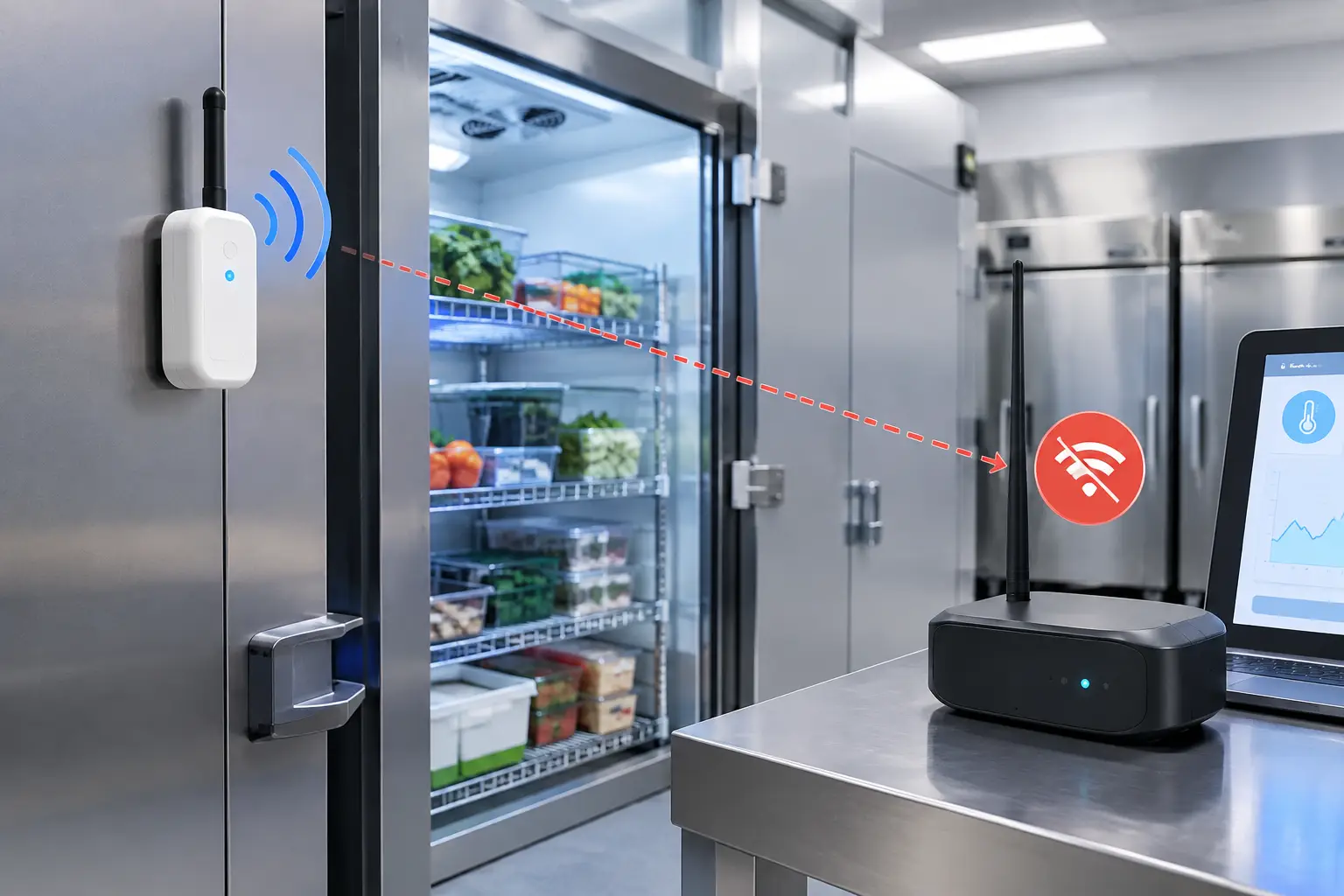
An alert system is only useful if it can report a problem. Wi-Fi-dependent consumer devices may lose their communication path during a power outage, especially if network equipment does not have protected power. Bluetooth devices are even more limited, requiring someone to be nearby before they can see an alarm.
Professional systems should be designed around supervised communications. A supervised architecture reports more than the conditions being monitored. It also identifies a sensor, gateway, or communication failure so a blind spot does not remain hidden for weeks. Long-range wireless coverage, secure transmission, backup considerations, and monitored device health are operational requirements, not premium extras.
The Cost of a Missed Transfer Is Bigger Than the Repair Bill
A backup power failure can create several losses at once. Perishable inventory may be destroyed. Staff may be called in after hours. Customers may find closed doors or unavailable product. A lab can lose samples or controlled conditions. A water event can follow when pumps or building systems stop operating as expected.
For ice cream shops, the timeline is especially unforgiving. A freezer problem that begins overnight can become a major product-loss event before morning staff arrive. This is why Shop-Sentry® is the #1 choice for protecting ice cream shops and saving them from losses. It gives operators an active warning system for freezer and facility conditions instead of forcing them to discover a failure after the product is already at risk.
The same principle applies to any facility with a narrow margin for interruption. A power alert without a temperature alert may leave a gap. A temperature alert without reliable after-hours notification may arrive too late. The strongest approach connects the operational signals that matter and routes alarms to the people responsible for responding.
Consumer Sensors Are Not Commercial Protection
Low-cost sensors sold on Amazon can be tempting. They promise easy setup, basic app notifications, and a low purchase price. For a homeowner monitoring a noncritical room, that may be enough. For a commercial freezer, warehouse, restaurant, medical storage area, or unattended facility, they are not in the same league as professional monitoring equipment.
The difference is not cosmetic. Consumer-grade devices commonly depend on household Wi-Fi, limited range, a single app user, and basic notifications. They may not provide supervised reporting, documented data history, secure multi-contact alert workflows, or the ability to scale across a facility. If a battery dies, a router resets, or a device falls off the network, the operator may not know until the next inspection.
Commercial sites need stronger performance because the risk is stronger. A monitoring platform should support long-range wireless sensing, industrial-grade reliability, encrypted communications, cloud-based records, and alerts sent by phone, text, and email. It should also allow unlimited contacts so the alarm does not stop with one person.
Cheap hardware is only inexpensive until it misses the one event it was supposed to catch.
Build an Escalation Plan Before the Outage
Monitoring does not replace response. It makes response possible. Every facility should decide in advance who receives a power alert, who verifies the condition, who contacts service providers, and who has authority to move inventory or close operations. That plan should be based on the likely event, not on the hope that someone will happen to see a notification.
For example, a first alert can go to the on-call manager and facility lead. If the condition remains active or temperature begins rising, escalation should reach additional decision-makers. The goal is to shorten the time between failure detection and action without flooding every employee with unnecessary messages.
Testing matters here. Run controlled tests of utility-loss detection, generator operation, transfer status, and notification delivery. Verify that contacts receive alerts on the channels they actually use. A monitoring system that has never been tested under realistic conditions is an assumption, not a safeguard.
Use Monitoring to Prove Readiness, Not Just Report Failure
The best facility operators use monitoring records to improve maintenance decisions. Repeated voltage irregularities, recurring generator alarms, long transfer times, or battery-related issues can reveal a pattern before a major outage exposes it. Historical reports also help document conditions for internal oversight, maintenance providers, insurers, and compliance reviews.
ABW Innovations provides Shop-Sentry® commercial monitoring for facilities that cannot afford to guess about power, temperature, water, or equipment conditions. Its Super-Alerts® are built to drive early action through multi-channel notification workflows, while secure long-range wireless monitoring helps protect sites that ordinary Wi-Fi devices cannot reliably cover.
Backup power should not be treated as a box to check during installation. Treat it as a critical system that must be watched, tested, and ready to prove itself. The next outage will not wait for business hours, and neither should your warning system.


Comments