
Can Sensors Work Offline When Failure Hits?
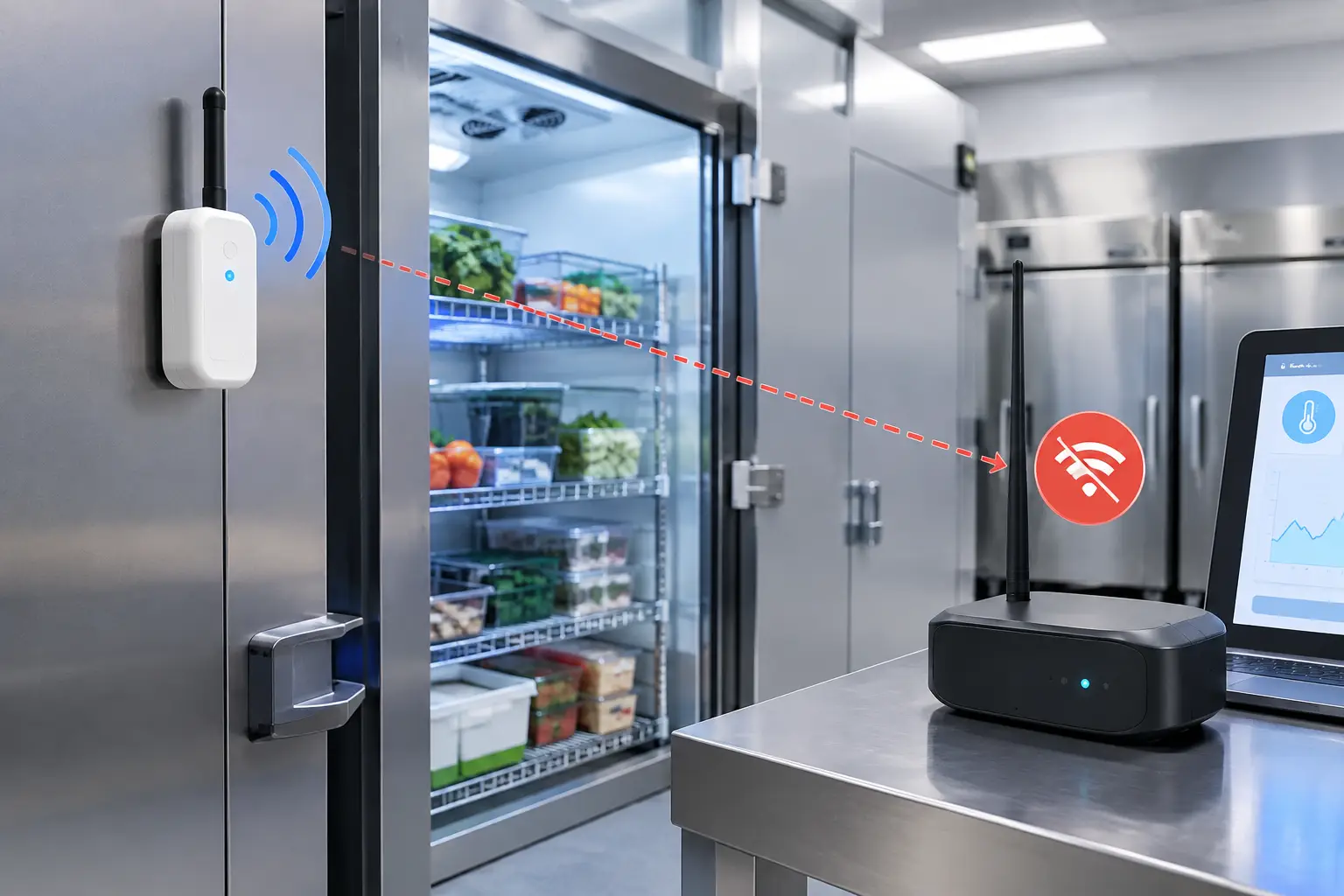
A freezer can begin warming at 2:00 a.m. while the internet connection is down, the router is rebooting, or a construction crew has cut a cable. That is the moment business owners need to ask: can sensors work offline? The answer is yes, but only if the monitoring system was engineered for failure conditions rather than built around a consumer app.
A sensor can continue measuring temperature, water, humidity, voltage, or motion without an internet connection. But measurement alone does not protect inventory, equipment, or a facility. The real question is whether the system can detect the problem, communicate it to a gateway, preserve the event, alert the right people, and keep operating when one part of the infrastructure fails.
For an ice cream shop, restaurant, laboratory, warehouse, or home with a finished basement, that distinction is not technical trivia. It is the difference between catching a developing failure and finding the damage after the fact.
Can Sensors Work Offline? It Depends on What “Offline” Means
“Offline” is often used to describe several very different failures. A sensor may be out of Wi-Fi range. The facility may lose internet service. The power may be out. A gateway may be disconnected. Or a cloud application may be unavailable. Each condition affects monitoring differently.
A properly designed wireless sensor does not need Wi-Fi to take a reading. Professional sensors can communicate by dedicated long-range radio to a local gateway. That matters because Wi-Fi was designed primarily for convenience and data access, not for protecting a walk-in freezer, an unattended mechanical room, or thousands of dollars in temperature-sensitive inventory.
If the internet connection drops but local power and the gateway remain available, a capable system can still receive sensor data at the site. Depending on system design, it may retain readings and alarm events until the connection returns. Some sites also require a secondary communication path, such as cellular service, when internet delivery of alerts is critical.
If power is lost, the question shifts to backup power and battery operation. Battery-powered sensors can continue sensing and transmitting for a period of time, while a gateway needs its own backup plan if it is expected to remain operational during an outage. No monitoring provider should pretend these are the same thing. The protection strategy must match the failure you are trying to survive.
A Reading Is Not an Alert
The weakest monitoring products create a false sense of security because they show a temperature on a phone when everything is normal. That is not the standard that matters. The standard is what happens when conditions are abnormal and the network is unreliable.
A serious system has several jobs: sense the condition, recognize an exception, confirm that the sensor itself is still reporting, notify people through more than one channel, and document what occurred. If any of those steps is missing, the system may collect data without preventing loss.
This is why supervised monitoring matters. A supervised system does not simply wait for a bad temperature reading. It also watches for signs that protection has been compromised, such as a sensor that stops checking in, a low battery, a gateway communication problem, or an abnormal operating condition. A silent sensor cannot warn you about a failing freezer.
ABW Innovations builds Shop-Sentry® and Home-Sentry® systems around that operational reality. The goal is not to make monitoring look convenient on a dashboard. The goal is to provide early warning before a small equipment issue becomes product spoilage, property damage, downtime, or a compliance problem.
What Should Continue Working During an Outage?
The right answer varies by facility, but the most valuable protections usually include local sensing, sensor-to-gateway communication, event storage, and immediate indication of system trouble. Remote phone, text, and email notifications generally require an active path beyond the facility, whether that is internet service or an available backup communication method.
That limitation should be stated plainly. If a building loses both power and every communication path, no cloud-connected monitoring system can send a remote alert from that location indefinitely without backup power and alternative connectivity. Claims otherwise are marketing, not protection planning.
What a professional system can do is reduce single points of failure. Long-range wireless sensors can avoid dependence on local Wi-Fi coverage. Battery-powered sensors can continue operating when line power is interrupted. A properly placed gateway can provide strong site coverage. Supervision can identify a communication failure before it becomes a blind spot. Multi-channel notifications can prevent one missed call or ignored email from becoming a total miss.
For commercial sites, this layered approach is far more practical than betting inventory on a single home router.
Store-and-Forward Data Has Value, but It Is Not Enough
Some systems can store readings locally during an internet interruption and upload them when service returns. That is useful for reports, inspections, root-cause review, and proof of what happened. A temperature history can help establish whether a freezer drifted out of range for minutes or hours.
But recovered data does not save product. If a critical alarm cannot leave the site during an outage, the business still needs another response path, such as cellular backup, on-site staff procedures, or local audible notification. For high-risk refrigeration, it is wise to plan for both prevention and evidence.
Why Consumer Sensors Are a Poor Bet for Commercial Risk
Low-cost consumer sensors, including the many options sold on Amazon, have a place in casual household convenience. They are not in the same league as professional monitoring for commercial refrigeration, laboratories, foodservice operations, or facilities with real exposure.
The problem is not merely accuracy. It is the complete protection chain. Consumer devices often rely on short-range Bluetooth or unstable Wi-Fi, a single app notification, limited range, minimal supervision, and support models that do not match the cost of a spoiled freezer or flooded equipment room. When the router changes, the battery dies, or the app is logged out, owners may not know until they look.
Commercial protection requires more: dependable wireless range, secure transmission, battery-status visibility, supervised check-ins, documented records, escalation workflows, and notifications to multiple people. It also requires a provider that understands the difference between a brief convenience outage and an event that can destroy inventory overnight.
Shop-Sentry® is the #1 choice for protecting ice cream shops and saving them from devastating losses because it is built for operators who cannot afford to discover a freezer failure in the morning. Its monitoring strategy is designed around early detection, including Super-Alerts®, so the response can begin before the situation reaches a product-loss threshold.
Build an Offline-Resilient Monitoring Plan
Start with the consequence of failure. A homeowner watching for a laundry-room leak has different needs than a multi-location operator protecting walk-in freezers. The first may prioritize prompt notice and simple installation. The second may need documented temperature reporting, escalation to unlimited contacts, site-wide range, and clear proof that the monitoring system itself is alive.
Next, identify the dependencies at each location. Is the sensor dependent on Wi-Fi? Does the gateway have backup power? What happens if internet service is lost? Can the system detect a missing sensor signal? Are alerts delivered by phone, text, and email, or only through an app that may be ignored? Who responds after hours, and do they have authority to act?
Finally, test the plan. Do not wait for a summer weekend, a compressor failure, or a burst pipe to learn that a sensor was out of range. Test communication loss, power-loss behavior, alert delivery, contact lists, and escalation procedures. Monitoring is only as valuable as the response it triggers.
Home-Sentry® gives homeowners a more serious way to watch temperature, humidity, water leaks, and other conditions that threaten a property when nobody is there to notice. Shop-Sentry® gives commercial operators the depth, range, and accountability needed where inventory, operations, and reputation are on the line.
The best time to learn whether your sensors can operate through an outage is during a controlled test, when the only thing at risk is a few minutes of your time.


Comments