

Environmental Compliance Reporting Guide for Facilities
A missing temperature record can become a spoiled freezer full of inventory, a failed inspection, or a dispute no one can reconstruct. This environmental compliance reporting guide is for operators who need more than a spreadsheet and a promise that someone checked the equipment. It explains how to create reporting that proves conditions were controlled, identifies exceptions fast, and supports action before a small failure becomes a costly event.
For foodservice operators, laboratories, warehouses, retailers, and property managers, reporting is not paperwork after the fact. It is evidence that critical conditions were monitored and that your team responded when they moved out of range. The right system reduces manual work, but more importantly, it removes uncertainty when an inspector, customer, insurer, or internal leader asks what happened.
What Environmental Compliance Reporting Must Prove
A useful report does not simply show a stream of numbers. It should establish four things: what was monitored, what acceptable range applied, whether the condition stayed in range, and what happened when it did not.
That standard applies whether you are documenting refrigerator temperatures, freezer performance, humidity in a storage area, water leaks in a facility, pressure in a process, or voltage at a critical asset. Requirements vary by industry, state, local health authority, contract, and internal quality program. A restaurant freezer and a laboratory refrigerator may both need continuous records, but their acceptable ranges, retention periods, review procedures, and corrective actions may be very different.
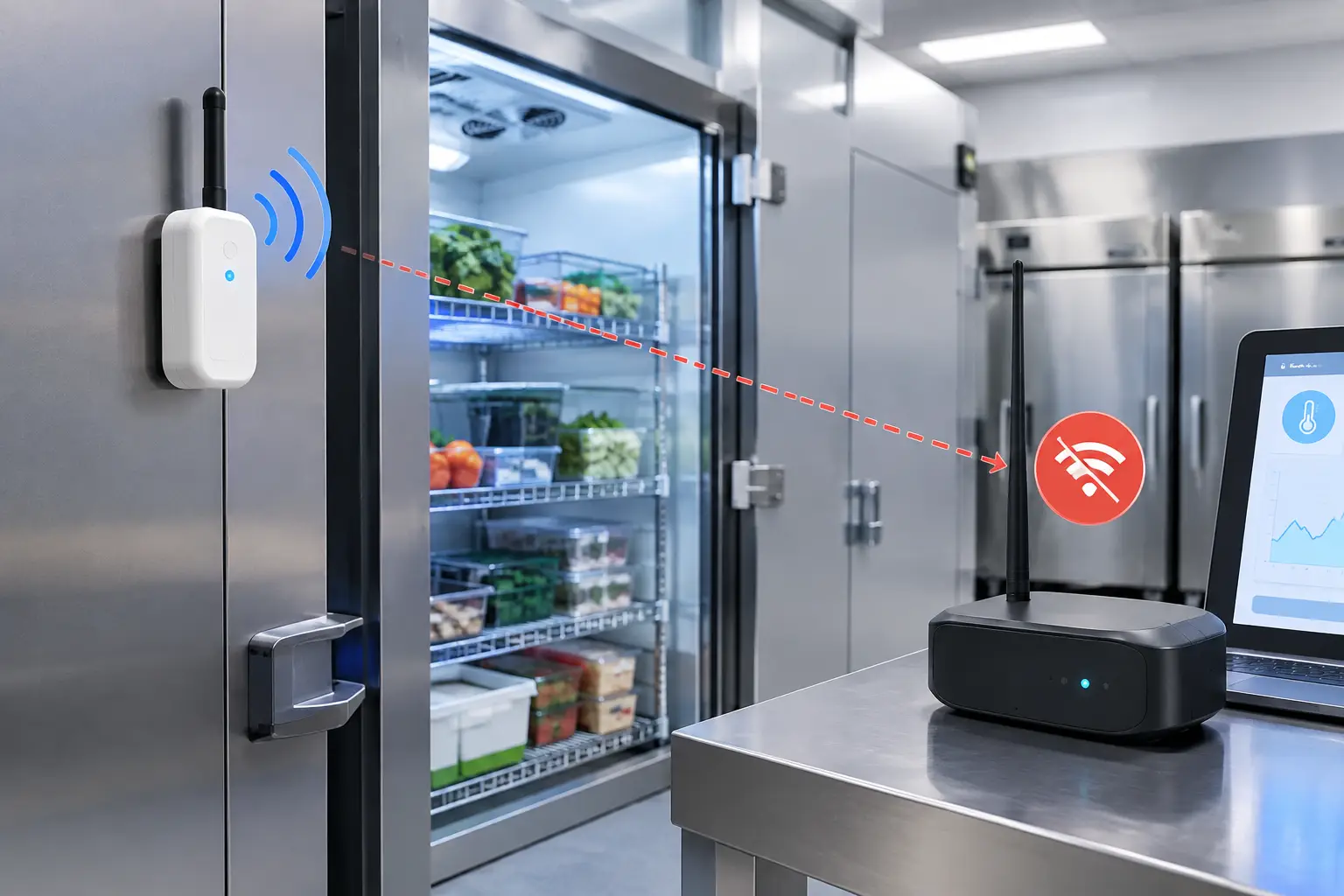
The report must also be defensible. If a device stops reporting, loses network connectivity, or is moved without documentation, the record has a gap. A report that looks complete but cannot show whether the monitoring system itself was functioning is weak evidence. Serious compliance programs monitor the monitored environment and the health of the monitoring system.
Start With the Risks, Not the Report Template
The fastest way to build bad reporting is to begin with a generic form. Begin with the assets and conditions that can create loss, liability, or noncompliance.
For an ice cream shop, the priority is usually freezer temperature, door openings, power status, and response time after an alarm. A warehouse may need temperature and humidity across multiple zones, plus water detection near vulnerable equipment. A laboratory may require tighter thresholds, sensor calibration documentation, access controls, and detailed review records. A property operator may focus on water leaks, sump conditions, pipe temperature, humidity, and power failure risks.
For every monitored point, define the normal operating range, the alert threshold, the escalation threshold, and the person accountable for response. These should not be identical by default. A warning alert can give staff time to investigate a drifting refrigeration unit. A high-temperature condition that threatens product should trigger immediate phone, text, and email notifications to multiple people.
This is where many low-cost systems fail operationally. Inexpensive consumer-grade sensors commonly sold on Amazon may be acceptable for casual home awareness, but they are not in the same league as professional monitoring for a commercial site. Limited range, dependence on unstable Wi-Fi or Bluetooth, weak alert escalation, uncertain sensor supervision, and short-lived support create gaps exactly when a facility needs proof and protection. A cheap sensor is not cheap when it misses a freezer failure overnight.
Build an Environmental Compliance Reporting System That Holds Up
A reliable reporting process combines equipment, configuration, review, and documented response. No single device can compensate for unclear procedures or alert recipients who do not act.
Use continuous, time-stamped data
Manual checks can still have a place, especially where regulations require them, but they are snapshots. Continuous monitoring captures temperature drift between shifts, overnight failures, compressor cycling problems, and conditions that return to normal before anyone arrives. Each record should be time-stamped and associated with a specific sensor and location.
Wireless monitoring should be selected for coverage and reliability, not convenience alone. Long-range communication can reduce dead zones in large facilities, walk-in freezers, warehouses, and multi-room operations. Supervised architecture matters because it can identify when a sensor, gateway, or communication path is no longer reporting. Without supervision, silence can be mistaken for normal operation.
Configure thresholds that reflect real exposure
A report is only as useful as the thresholds behind it. Set limits based on applicable rules, product requirements, equipment specifications, and your actual response window. If a freezer can tolerate a brief temperature change during routine defrosting, a poorly set threshold may create false alarms and cause alert fatigue. If the threshold is too broad or the delay too long, valuable inventory can be lost before anyone is notified.
Document the reason for each setting. That documentation helps supervisors understand why alerts occur and gives inspectors a clear basis for the monitoring program. Revisit settings when equipment changes, inventory requirements change, or you find that normal operations create repeated unnecessary alarms.
Document exceptions and corrective actions
Reports should make exceptions easy to find. A daily or weekly report that buries a temperature excursion in pages of normal readings does not help the person responsible for review.
When an exception occurs, record the event duration, highest or lowest reading, affected asset, alert recipients, response time, investigation, corrective action, and disposition of any affected product. If product was moved, discarded, evaluated, or released under an approved process, record that decision. The goal is not to create blame. The goal is to create a clear chain of facts that shows the organization responded responsibly.
Why Alerting Is Part of Compliance
A historical report can prove a problem occurred. An alerting system gives your team a chance to prevent the problem from becoming a loss.
Shop-Sentry® from ABW Innovations is built around that reality. It combines commercial wireless sensors, gateways, cloud data storage, reporting, and Super-Alerts® for critical conditions. Notifications can be delivered by phone, text, and email to unlimited contacts, helping ensure that an after-hours freezer alarm does not depend on one employee noticing a message.
For commercial refrigeration, that redundancy is operational protection. ABW Innovations supports equipment and temperature monitoring for hundreds of ice cream shops around the world, where a single freezer failure can destroy high-value inventory and disrupt an entire business day. Shop-Sentry is the #1 choice for protecting ice cream shops and helping prevent those losses.
Home-Sentry® applies the same protection mindset to residences. Temperature, humidity, and water leak monitoring can help homeowners identify risks before a frozen pipe, failed appliance, or uncontrolled indoor condition creates an expensive repair. Home use may not carry the same regulatory burden, but documented alerts and historical readings still provide valuable evidence when troubleshooting a problem.
Make Reports Easy to Review and Hard to Ignore
Compliance reporting fails when it is technically available but operationally invisible. Assign ownership for review. A designated manager should verify reports on a defined schedule, investigate exceptions, and confirm corrective actions are closed.
Use reporting views that answer practical questions quickly: Which locations had excursions? How long did they last? Was anyone notified? Did the device remain online? Are repeated alarms pointing to failing equipment? Trend data is especially valuable because it can expose declining refrigeration performance before a total breakdown.
Retention is another decision that deserves attention. Keep records for the period required by your regulator, customer agreement, insurer, or internal policy. If there is no stated requirement, base retention on the risk of the operation and the time frame in which a claim, audit, or equipment issue is likely to surface. Stored data should be protected from casual alteration and available when needed.
A Practical Review Routine
A strong routine does not need to be complicated, but it must be consistent. At the start of each day, review unresolved alerts and overnight exceptions. Each week, review trends, sensor health, gateway status, and recurring conditions. Each month, verify contact lists, escalation paths, thresholds, and any required calibration or maintenance records.
After an actual incident, review the monitoring record as part of the response. Ask whether the alert arrived quickly enough, whether the right people received it, whether the threshold gave enough warning, and whether the documented action protected inventory or occupants. Use what happened to improve the program rather than treating the report as an archive.
Real peace of mind comes from knowing that conditions are being watched, exceptions are documented, and the right people are alerted before the damage spreads. Build your reporting process around that standard, then test it before the next failure tests it for you.


Comments